
AI and Agriculture in Africa: Feeding One Billion People Through Intelligent Farming
How artificial intelligence is being applied to Africa's most important sector — transforming smallholder farming, supply chains, and food systems with implications for the continent's food security.
Agriculture is simultaneously Africa's largest economic sector, its largest employer, and its most underperfoming major industry. African smallholder farmers — who farm plots of typically 0.5–2 hectares, producing staple crops and some cash crops for household consumption and local sale — produce yields 2–5 times lower than agricultural benchmarks in comparable climate and soil conditions elsewhere. The gap is not primarily genetic or geographic — it is informational, financial, and logistical. Farmers lack access to quality inputs, appropriate credit, reliable markets, and the agronomic knowledge to optimise their specific land. AI technologies are beginning to address each of these gaps in ways that were not possible even five years ago.
Satellite Intelligence and Precision Agriculture
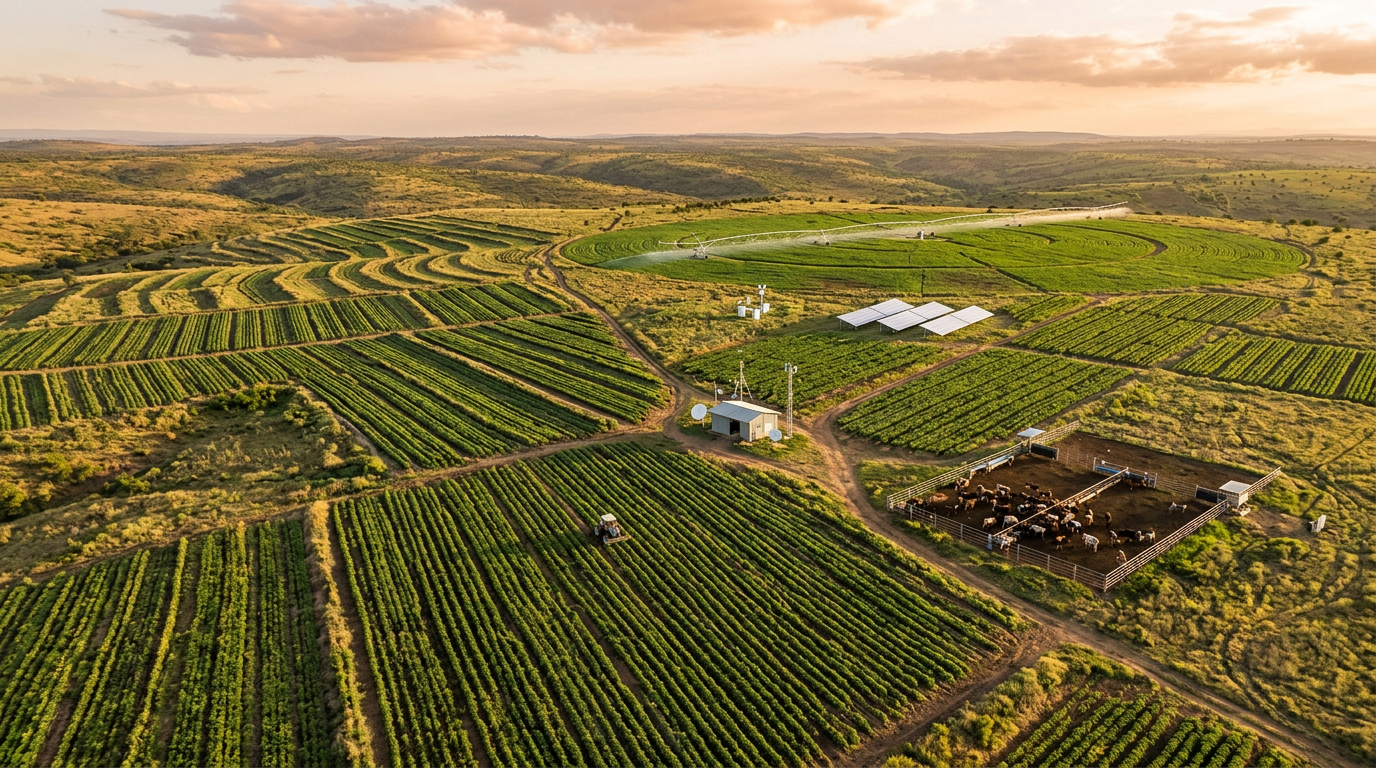
Satellite imagery combined with machine learning is the foundational technology of African agricultural AI. Satellite data can assess crop health across millions of hectares simultaneously — identifying areas of stress, predicting yields before harvest, detecting pest or disease outbreaks before they spread, and tracking weather patterns at the field level. This information, previously available only to large commercial farms with the resources to commission specialist surveys, is now deliverable to smallholder farmers through simple smartphone interfaces at rapidly declining cost.
Companies including NASA Harvest, Regrow Ag, and several African startups are building precision agriculture tools that use satellite imagery to generate field-specific agronomic recommendations. A farmer who previously applied a uniform dose of fertiliser across their entire plot — following general advice that was not optimised for their specific soil conditions, crop variety, and water availability — can now receive recommendations that differentiate by field zone, increasing efficiency and reducing input costs while improving yields.
Credit and Insurance Using Agricultural AI
The most commercially successful application of AI in African agriculture is credit scoring and insurance for smallholder farmers — using satellite data, weather records, and mobile phone usage patterns to assess risk in populations that are invisible to conventional financial institutions. Apollo Agriculture, Kenya-based and now operating in multiple African countries, uses a proprietary data model combining satellite crop assessment, rainfall data, and historical repayment patterns to underwrite input loans for smallholders who lack formal credit history. Pula Advisors uses satellite-based crop monitoring to trigger automatic insurance payouts when rainfall falls below a threshold or when satellite indices indicate crop failure — eliminating the claims assessment cost that makes conventional crop insurance unviable for smallholder-scale policies.
These business models demonstrate a critical principle of African agricultural AI: the highest-impact applications are those that combine data intelligence with financial products that create direct economic value for farmers. Information alone has limited uptake; information packaged with a financial product that acts on it drives both commercial viability and farmer adoption.
Supply Chain Optimisation
Post-harvest losses — food that is produced but does not reach consumers due to storage failures, transportation gaps, and market timing mismatches — are estimated at 30–50% of agricultural production in Sub-Saharan Africa. AI applications for supply chain optimisation attack this waste from multiple angles. Predictive demand models help traders and aggregators match supply volumes to market demand, reducing the oversupply that causes price crashes and the undersupply that causes spoilage. Route optimisation tools — using real-time traffic, road condition, and weather data — improve the efficiency of agricultural logistics. Storage condition monitoring using IoT sensors and AI analysis extends post-harvest crop life in grain stores and cold storage facilities.
Advisory Services: AI as Virtual Agronomist
Perhaps the most scalable AI application in African agriculture is the AI agronomist — a digital advisory system that provides personalised, expert agronomic guidance to farmers through voice or text interfaces on basic mobile phones. Traditional agricultural extension services — government or NGO employees visiting farms to provide agronomic advice — have never achieved sufficient coverage to serve the continent's 60+ million smallholder farmers. AI advisory systems that can answer farmer questions in local languages, provide planting advice based on current weather forecasts and satellite soil assessments, and alert farmers to pest and disease risks in their specific area, have the potential to democratise access to expert guidance that has historically been available only to larger, better-connected farmers.
Platforms including Zenvus and Hello Tractor are integrating AI advisory components into their agricultural services. The most ambitious vision — an AI system that provides every African smallholder farmer with the equivalent of a personal agronomist available 24/7 on their phone — is not yet achieved but is technically within reach as AI language models develop stronger multilingual capability and agricultural domain knowledge.
The Connectivity Constraint — And Its Solution
Agricultural AI in Africa faces an obvious deployment challenge: most smallholder farmers live in areas with limited or intermittent internet connectivity. The most impactful agricultural AI applications have addressed this directly: designing for offline functionality (core advisory tools that work without connectivity, syncing when connectivity is available); using USSD and SMS delivery channels for AI outputs that work on basic feature phones without internet; and increasingly leveraging Starlink and other satellite internet services whose rural expansion is progressively reaching agricultural areas. The connectivity gap is real but declining rapidly — and the agricultural AI companies that design for current connectivity constraints rather than assuming future ideal conditions will reach the most farmers most quickly.