Kigali Opportunity Index 2025: Africa's Most Functional City for Business
A comprehensive assessment of Kigali
Kigali is Africa's most counterintuitive city. A capital of a landlocked country of 14 million people with no natural resources and a devastating recent history — on paper, not the most promising startup city. In practice, a city that consistently outperforms its fundamentals through institutional quality, governance competence, and strategic vision in ways that make it genuinely attractive for specific categories of entrepreneur and investor. The Kigali Opportunity Index captures both the city's real strengths and its real limitations — because honest assessment of both is what enables good decisions.
Regulatory Environment Score: 10/10
Kigali's regulatory environment is the strongest in Africa — not aspirationally but operationally. Company registration is completed online in under 24 hours. The Rwanda Development Board provides genuinely effective one-stop investor facilitation. Tax compliance is straightforward with a well-designed e-filing system. Corruption is genuinely low — not just in survey rankings but in day-to-day business experience. Work permits for international employees are processed efficiently. And crucially, commitments made to investors by the government are generally honoured — a consistency that builds reputation over time and is the ultimate test of regulatory quality.
Infrastructure Score: 8.5/10
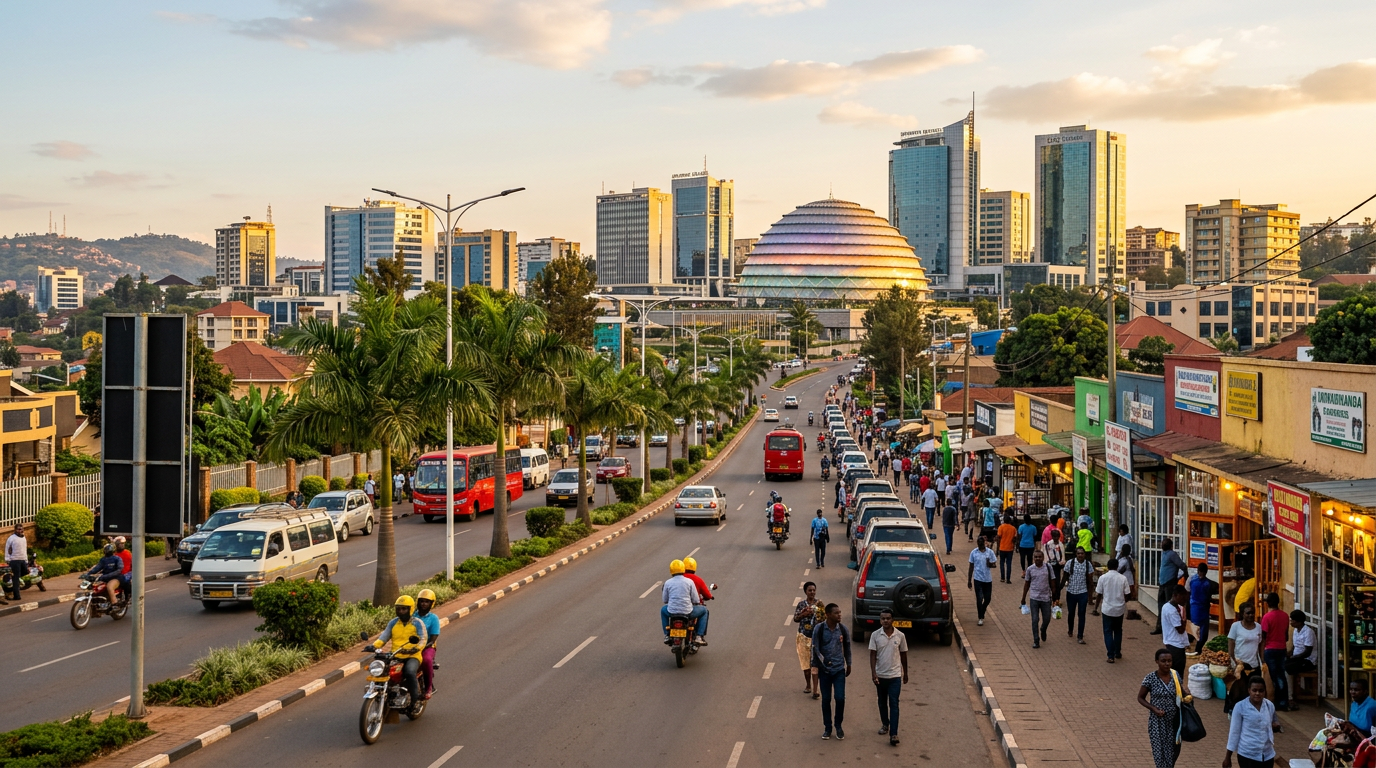
Kigali's infrastructure significantly outperforms its regional peers and is among Africa's strongest in absolute terms. Power supply is reliable — Rwanda's renewable energy grid (hydro, solar, methane from Lake Kivu) provides consistent electricity that businesses in Lagos or even Nairobi cannot take for granted. Road infrastructure within Kigali is well-maintained. Internet connectivity — via fibre in commercial areas and expanding mobile broadband — is reliable. The international airport provides direct connections to major African and European hubs. And Kigali's streets are clean — genuinely, conspicuously clean — in a way that reflects institutional commitment to urban quality that is rare in African cities of any size.
Startup Ecosystem Score: 6.8/10
Kigali's startup ecosystem is Nairobi or Lagos's most significant limitation relative to those peers: it is still developing the density and depth that makes ecosystem support genuinely transformative. The Rwanda Innovation Fund and several international accelerators have established presence; the upcoming Kigali Innovation City will provide significant physical infrastructure; and Carnegie Mellon University Africa's presence creates an anchor research and talent institution. But the number of experienced operators who have built and scaled companies in Kigali is smaller than in Nairobi or Lagos, reducing the mentorship and operator-angel density that established ecosystems provide.
Market Access Score: 6.0/10
Kigali's domestic market — Rwanda's 14 million people — is small for most startup ambitions. The city's value for market access comes from its regional positioning: as a base for East African Community market access (Uganda, Tanzania, Kenya, Burundi), as a hub for pan-African companies seeking a well-governed operational base, and increasingly as a MICE (Meetings, Incentives, Conferences, Exhibitions) destination that attracts significant international conference business. Companies that are genuinely pan-African from day one, rather than Rwanda-first, find Kigali's market access story compelling. Those whose primary market is the domestic Rwanda consumer face real scale constraints.
Quality of Life Score: 9.0/10
Kigali's quality of life is Africa's highest by most objective measures. Crime rates are extraordinarily low — Kigali is genuinely one of the safest cities of its size in the world. Air quality is good. Streets are clean. Traffic, while growing, is manageable relative to Nairobi or Lagos. Healthcare is accessible for those who can afford private facilities. International schools serve the expatriate community. And the surrounding Rwandan landscape — hills, lakes, national parks — provides extraordinary outdoor access. The trade-off is the political context: the social discipline that creates Kigali's exceptional public order and cleanliness is enforced through a system with limited political pluralism and press freedom that some residents find uncomfortable.
Opportunity Index Summary
| Dimension | Score | Key Strength | Key Gap |
|---|---|---|---|
| Startup Ecosystem | 6.8/10 | Improving infrastructure, international connections | Operator density, exit history |
| Talent Market | 7.0/10 | English proficiency, CMU Africa | Small pool, specialist skills scarce |
| Infrastructure | 8.5/10 | Power reliability, roads, internet | Airport capacity, logistics to coast |
| Regulatory Environment | 10/10 | Ease, consistency, low corruption | Political context concerns |
| Cost of Doing Business | 8.0/10 | Low corruption premium, operational efficiency | Import costs (landlocked) |
| Market Access | 6.0/10 | EAC hub, pan-African positioning | Small domestic market |
| Quality of Life | 9.0/10 | Safety, cleanliness, environment | Political freedom concerns |
| Overall Score | 7.9/10 | Africa's best regulatory environment; small market | |
Who Kigali Is Best For
Kigali is best for: pan-African companies seeking a high-quality operational base that is not Nigeria or Kenya's volatility; international companies establishing African headquarters who prioritise governance quality and operational efficiency; founders building global products who need a low-friction African base rather than a large domestic market; and professionals who value personal safety, clean environment, and institutional reliability above ecosystem density. It is less suited for: companies whose primary market is a large domestic consumer base; founders who need the ecosystem density and operator mentorship that only Nairobi and Lagos currently provide; and individuals who find the political context's constraints on civil society uncomfortable.